
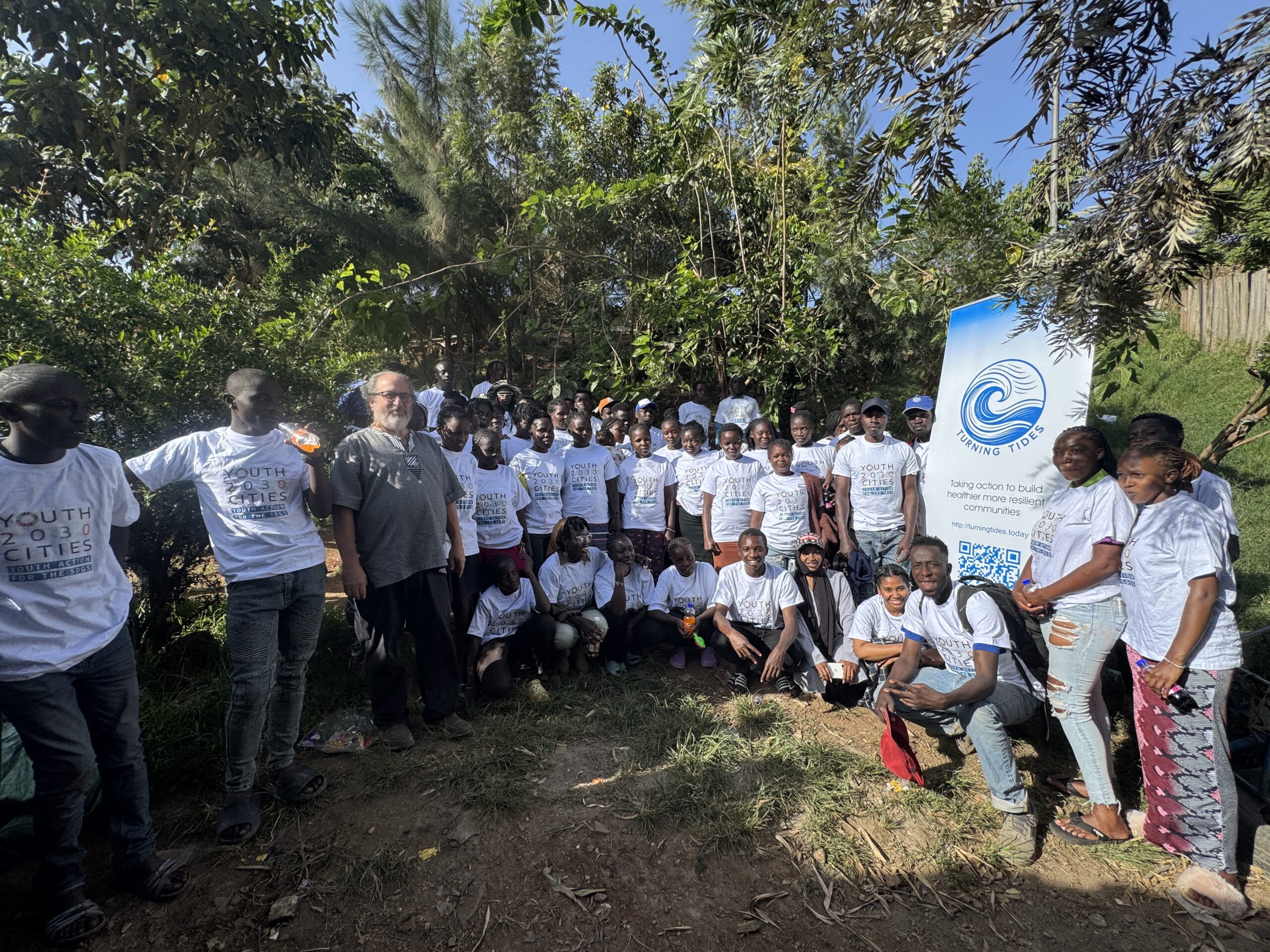

Mathare Community Park was recognised as a model of urban sustainable development during a gathering held at the park itself, bringing together Mathare residents and youth leaders and partners – the Mto Wangu Initiative, UN-Habitat, Youth 2030 Cities and Turning Tides. Held at the Park, the event marked a moment of collective acknowledgement of long-term community stewardship, youth-led action, and the restoration of a vital public and ecological space.
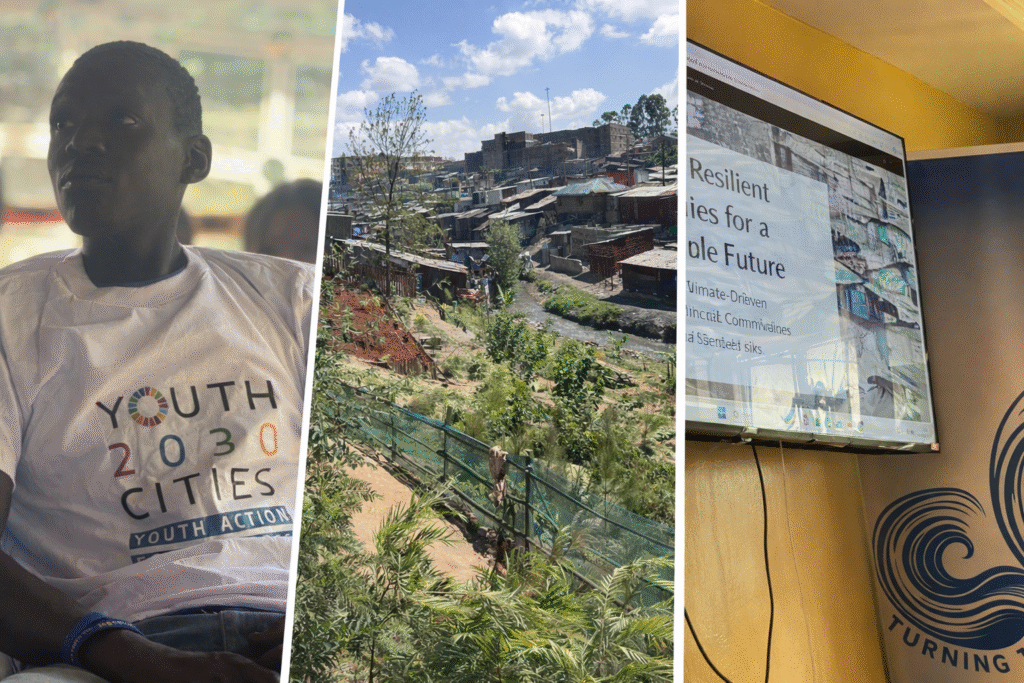
Situated along the Mathare River, the park has been progressively restored from a degraded and flood-prone site into a shared community asset. Residents reflected on how recurrent flooding has repeatedly damaged homes, displaced families, and disrupted livelihoods, transforming environmental risk into a broader housing and urban justice issue. In this context, the protection and rehabilitation of the river corridor and adjacent public space have become central to community resilience.
Restoration efforts have focused not only on clearing waste and stabilising the riverbanks, but also on reintroducing vegetation and improving the usability of the park for daily life. Community members highlighted the growing role of urban agriculture within and around the park, including small-scale planting and greening initiatives that support food security, improve soil stability, and contribute to cooling and flood mitigation. These activities were described as practical responses to constrained land, limited access to green space, and rising living costs in Mathare.
A core theme of the recognition was the use of community-led data and mapping to support restoration and accountability. Through the Roots Community Library E-Lab, youth have documented flood risks, blocked drainage points, restored areas, and community facilities. Mapping is used alongside storytelling, music, and visual documentation to articulate local priorities and engage ward and county authorities with evidence grounded in lived experience.
Speaking at the gathering, Doug Ragan reflected on the significance of community ownership in both the park and the wider river restoration work, as well as the donation of technology to the E-library:
“What makes this place powerful is that it was not designed from outside. The community decided to protect this space, to restore it, and to keep it open. Through the E-Library, the maps, the data and the stories will be tools you are using to say: this is where we live, and this matters.”
Youth coordinator Safrina Irungu emphasised how restoration and data work are inseparable from everyday survival and future aspirations:
“We live and work here along the Mathare River. Flooding affects our homes, our schools, and our livelihoods every year. By restoring the river and the park, and by mapping what is happening, we are taking responsibility for our community and making it safer for us and for the children growing up here.”
Representing UN-Habitat and the Youth 2030 Cities programme, Shamoy highlighted continuity and long-term engagement with youth and community structures in Mathare:
“This work did not start today, and it will not end today. What we see here is youth leadership that understands its community, its risks, and its strengths. Our role as both UN-Habitat and the Youth 2030 Cities programme is to walk with you as you continue restoring these spaces, building knowledge, and shaping what comes next.”
Founders of Mathare Community Park reflected on how the space now hosts meetings, learning, cultural expression, and everyday recreation – fulfilling a long-held community vision. The park’s restoration and protection during periods of flooding and development pressure were repeatedly cited as evidence of collective agency and commitment.
George Gachie, long-time Mathare youth and community advocate, stated “I would like to recognize key partners other than the ones represented here who have worked with Mto and the Mathare community. The Canadian High Commission, the Zero Waste Foundation, and UN Environment Programme have supported this work in ways that respect community leadership and local knowledge. Their partnership has helped us restore this park, protect the river, and strengthen the resilience of our community for the long term.”
The recognition at Mathare Community Park underscored a locally driven model of urban resilience. By linking river restoration, urban agriculture, public space, and community-held data, youth and residents are actively shaping how Mathare responds to climate risk and urban change. The park stands not only as a restored site, but as a living demonstration of how community-led action can reclaim space, strengthen accountability, and sustain life along the river.